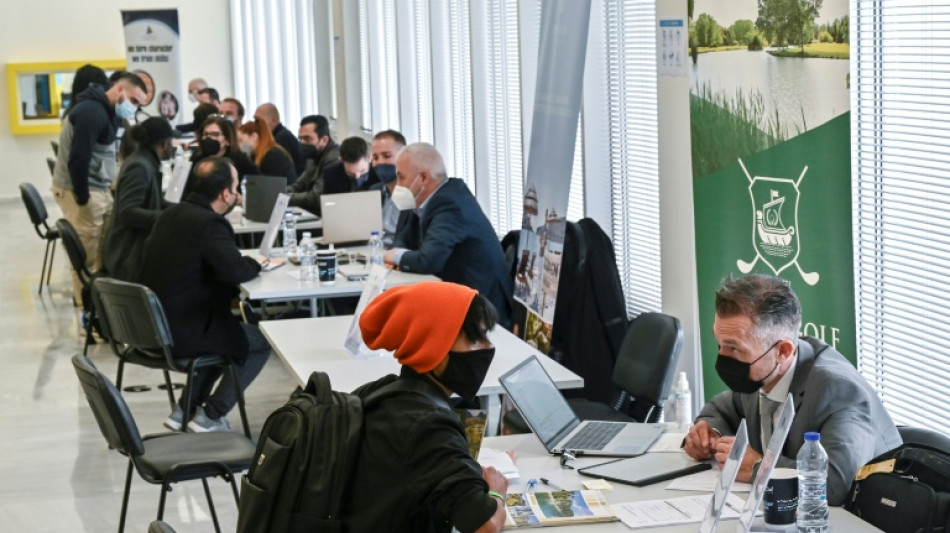
Refugees in Greece face hunger, homelessness despite status / Photo: ©

 Climate-threatened Fijian utopia rejects calls to relocate

 Bolsonaro's party says it recognizes Lula's election win in Brazil
 Meghan on TV menu for 'Junior MasterChef Australia'
 South Korea's chip boom fuels forecast-beating third-quarter growth

 US-brokered truce begins in Ukraine city occupied by Russia

 Qatar launches Fashion and Crafts Council to connect talent with global markets

 Jordan strikes militant groups in Syria after church attack

 FIA chief praises Middle East motorsport volunteers and officials
 Australia warns of 'unprecedented' AI threat

 Qatar Amir arrives in Moscow for eighth GECF summit

 Kane beats Yamal and Mbappe to taste Ballon d'Or glory

 Ballon d'Or crowns Putellas's return to top of women's game
 Godts stars as PSG beat Lyon to go top of Ligue 1

 NBA inks deal with Kalshi and Polymarket, citing safeguards

 US rapper Macklemore launches 'Free Palestine Tour' after Ed Sheeran fallout

 Venezuela leader criticizes Machado over dramatic return from exile

 Brazil markets battered after Lula win, AI in focus elsewhere
 Lula savors Brazil win as Bolsonaro rejects result, markets tumble

 Canadian youths ask court to impose binding climate protections

 Walter Koenig, who played original Chekov on 'Star Trek,' dies at 90
 Netanyahu, rivals trade attacks over Iran as clock counts down to Israel vote
 Townsend urges Scotland to use Nations Championship as World Cup springboard

 Microsoft offers voluntary exit packages to 60,000 staff
 S.Africa ambassador calls for talks with US over 'tense' ties
 'Smells of freedom': Serbians hopeful after landmark election

Two minutes into a Greek jobs fair interview, Hashim, a 21-year-old Afghan refugee, is offered work as a waiter at a swanky Corfu hotel.
It's his ticket out of the grim migrant camp he has called home for the past year, but there's a caveat: he has to cut his ponytail.
"Health and safety protocol," his interviewer explains.
Hashim, who won asylum in Greece a month-and-a-half ago, has little choice.
"If I do not have work, I need the camp," he explains in a mix of broken English and Greek, summing up the predicament of many refugees in Greece.
Athens has granted refugee status to over 68,000 people in the past three years, according to the migration ministry.
But if obtaining asylum in an EU country is a dream come true for many migrants, in Greece it means having to confront a whole new set of challenges.
Right now "it's probably easier to survive in Greece as an asylum seeker than as a refugee," says Spyros-Vlad Oikonomou, advocacy officer at the Greek Council for Refugees, one of the country's leading rights groups.
"It's a particularly sad paradox... essentially, Greece still has no integration system," he told AFP.
Starting in 2019, the conservative government began phasing out accommodation and financial assistance for people with asylum status, arguing that such benefits only encouraged further migration.
"Our country will not give refugees lifelong pensions and accommodation," Migration Minister Notis Mitarachi said at the time.
"A month after asylum (is granted), provision of shelter, food and financial support stops. Whoever wants to stay in this country must be able to work, get back on their feet," he told Parapolitika daily.
Since then, Greece has shut down an EU-funded accommodation programme that was housing over 6,500 approved refugees and passed a law requiring them to leave the country's migrant camps once they get the nod to remain in Greece.
- 'Same rights' as Greeks -
Louise Donovan, communications officer for refugees with the UN refugee agency in Greece, said the 30-day grace period was "very short" compared to other EU member states and that many refugees struggle to put a roof over their heads.
Many gravitated towards Athens to seek help in finding shelter, or contacts to enable them to leave the country.
Some lived in public squares or squats.
But others remained in migrant camps in violation of the rules, with some 500 ending up in the Eleonas camp near central Athens which is slated for closure this year.
In October, 26 rights organisations accused Greek authorities of leaving people in camps, including refugees, short of food.
"Though practices differ from region to region, it is roughly estimated that 60 percent of people living in camps do not receive food in the mainland," the groups said.
The migration ministry replied that asylum recipients were not supposed to be in camps in the first place.
It noted that they have the "same rights" as Greek citizens and can apply for jobs and state health coverage.
- 'No jobs' -
But several people with refugee status interviewed by AFP and others who spoke to rights groups tell a different story.
With unemployment in Greece still officially at around 13 percent, 36-year-old Cameroonian Yannick Ghislain Dzernyuy says there are "literally no jobs, and the ones you have (pay) very little."
Obtaining social insurance and tax registration can take months, and it's nearly impossible to learn Greek while working at the same time, refugees say.
Under the Helios scheme run in cooperation with the International Organization for Migration, newcomers can avail of six-month integration classes and limited rent subsidies.
But only refugees who gained the right to remain after 2018, or those already living in state-provided accommodation when they were granted asylum, may benefit.
Currently, fewer than 1,700 people are receiving the rental subsidies, and around 600 are enrolled in integration classes.
- Moving west -
Forced onto the streets, thousands of refugees have left Greece for other EU states on short-term travel documents.
In June, the home affairs and migration ministers of Belgium, France, Germany, Luxemburg, the Netherlands and Switzerland jointly complained to the European Commission that "considerable" numbers of refugees were travelling from Greece and lodging new asylum claims elsewhere.
More than 17,000 people who had already received refugee status in Greece have requested asylum in Germany since July 2020, said a joint letter by the ministers, seen by AFP.
Complaining of "flagrant abuse" of provisions allowing refugees 90-day travel through the Schengen Area, they urged the Commission to work with Greece on improving conditions for the "physical subsistence" and integration of refugees in the country.
"It is of utmost importance to us all, that the situation in Greece improves," the ministers said.
Athens is now working on a new integration plan. In October, UNHCR agreed to give Greece "technical support" on simplifying administrative procedures and legal frameworks, Donovan said.
"We are discussing changes to open Helios to more participants" and place more emphasis on skills training, deputy migration minister Sofia Voultepsi told AFP.
F.Müller--BTB