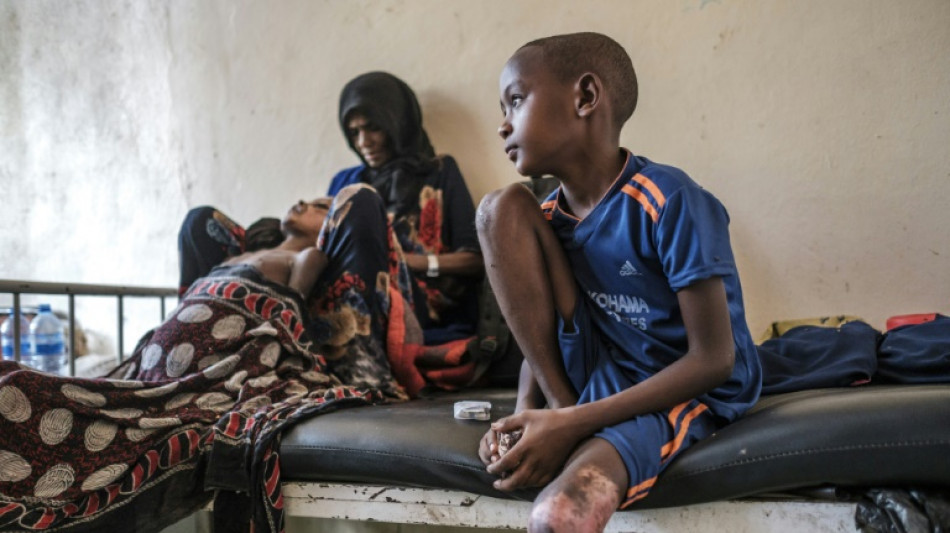
'Afar has been raided': Suffering stalks Ethiopia's forgotten front / Photo: ©

 Climate-threatened Fijian utopia rejects calls to relocate

 Bolsonaro's party says it recognizes Lula's election win in Brazil

 Meghan on TV menu for 'Junior MasterChef Australia'
 South Korea's chip boom fuels forecast-beating third-quarter growth

 US-brokered truce begins in Ukraine city occupied by Russia

 Qatar launches Fashion and Crafts Council to connect talent with global markets

 Jordan strikes militant groups in Syria after church attack

 FIA chief praises Middle East motorsport volunteers and officials

 Australia warns of 'unprecedented' AI threat

 Qatar Amir arrives in Moscow for eighth GECF summit

 Kane beats Yamal and Mbappe to taste Ballon d'Or glory

 Ballon d'Or crowns Putellas's return to top of women's game

 Godts stars as PSG beat Lyon to go top of Ligue 1

 NBA inks deal with Kalshi and Polymarket, citing safeguards

 US rapper Macklemore launches 'Free Palestine Tour' after Ed Sheeran fallout

 Venezuela leader criticizes Machado over dramatic return from exile

 Brazil markets battered after Lula win, AI in focus elsewhere

 Lula savors Brazil win as Bolsonaro rejects result, markets tumble

 Canadian youths ask court to impose binding climate protections

 Walter Koenig, who played original Chekov on 'Star Trek,' dies at 90

 Netanyahu, rivals trade attacks over Iran as clock counts down to Israel vote

 Townsend urges Scotland to use Nations Championship as World Cup springboard

 Microsoft offers voluntary exit packages to 60,000 staff

 S.Africa ambassador calls for talks with US over 'tense' ties

 'Smells of freedom': Serbians hopeful after landmark election

The shell crashed through Aicha Nur's flimsy hut just as she was serving a lunch of bread and milk to her nine-year-old son Tahir.
His slim body quickly became engulfed in flames.
She grabbed Tahir and another son before fleeing on foot to safety, dodging an artillery assault allegedly carried out by Tigrayan rebels on her village in northern Ethiopia's Afar region.
They managed to escape, but Aicha's six other children remain unaccounted for.
She worries she has lost them forever to what has quietly emerged as the most active front in Ethiopia's grinding war.
More than 15 months since the first shots rang out, foreign envoys are talking up paths to peace for Ethiopia and Prime Minister Abiy Ahmed publicly refers to the conflict in the past tense.
But Afar is enduring its roughest period yet, sparked by a fresh rebel offensive that has yielded massive destruction and displacement, according to officials and residents.
Across the arid, punishingly hot region, shell-shocked survivors await food handouts at schools that have been transformed into makeshift displacement sites.
Afar's only referral hospital is stretched well beyond its bed capacity, with doctors running low on anaesthesia amid a seemingly endless influx of civilians with fractured limbs.
All the while, patients wonder aloud why no one seems to be paying attention, complaining that "their voices haven't been heard", said hospital CEO Hussein Aden.
"We've been dying for a long time now, but nobody has listened to us," Aicha told AFP as she propped Tahir up on his hospital bed, fanning away flies from his burned and blistered face.
- Outgunned -
The war erupted in Ethiopia's northernmost Tigray region in November 2020, but Afar did not see combat until July 2021 when the Tigray People's Liberation Front (TPLF) rebel group expanded its operations.
Late last year, fighting intensified in Afar before Abiy, winner of the 2019 Nobel Peace Prize, deployed to the region as part of a counter-offensive that ultimately pushed the rebels back into Tigray.
Those bouts of hostilities pale in comparison to what Afar residents say has unfolded in recent weeks: unremitting attacks involving many more Tigrayan fighters and much heavier weapons, including tanks and automated cannons.
Afar forces, armed with Kalashnikov rifles and lacking military backing, have been thoroughly outgunned.
"You can't defeat mortars with a Kalashnikov," said Ibrahim Abdala, a militia fighter who was shot in the chest in Afar's Kuneba district this month.
- 'Not even a rug to sleep on' -
Afar civilians fleeing the latest attacks describe harrowing, days-long journeys on foot towards towns that are more secure but woefully ill-equipped to feed and shelter them.
Regional government documents seen by AFP indicate 294,000 people were displaced in January, and a regional spokesman said the number is now up to 350,000 since the start of the year.
It's unclear when or even if they will be able to return home, with Afar's western border reportedly occupied by the TPLF.
"All the schools, clinics, hospitals that were constructed in this space of time are now gone on the western border. The whole lot," said Valerie Browning, an aid worker who has lived in Afar for more than three decades.
"Afar has been raided, vandalised, and there is not that much left."
Her claims could not be independently verified.
On a recent afternoon, scores of women and children sat in a sweltering dried-out riverbed, clustered under shade provided by acacia trees and sharing food handouts as boys struggled to play football using a plastic water bottle.
"You see the truth with your own eyes. We have been evicted from our homes and are eating biscuits," said Mohammad Adem Endrisi, a 32-year-old schoolteacher from Kuneba.
"There are pregnant women among us... There is not even a rug to sleep on here."
- 'Path of destruction' -
Aid workers are also worried about sky-high malnutrition rates in Tigray.
The UN says recent fighting has made it impossible for humanitarian convoys to enter Tigray via the Afar capital Semera -- currently the only functioning overland route.
The TPLF has defended its push into Afar, saying it was provoked by attacks on its positions within Tigray and claiming it "does not have a plan to remain in Afar for long."
It also points out that Tigray has been under what the UN terms a "de facto humanitarian blockade" since long before the latest clashes erupted in Afar, while maintaining that its fighters have never prevented aid trucks from passing.
But that argument does not resonate with Afar residents.
"The TPLF has chosen the path of destruction, not the path of peace," said Ahmed Nuro, a local official in the border town of Abala.
"They will never stop firing."
E.Schubert--BTB