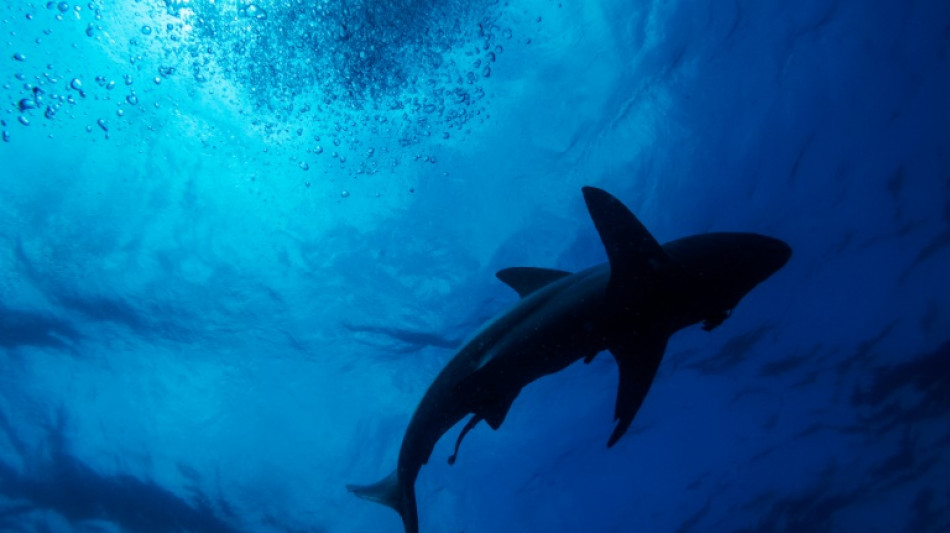
Global wildlife summit approves shark protections / Photo: © AFP/File

 Seoul dives on mixed day in Asia as Samsung fails to ease tech woes

 Belgium dump US out of World Cup after Balogun row

 How US is using cash and threats to dump migrants in Africa

 Democrat in key US Senate race denies sex assault claim

 Samsung expects 1,800% leap in quarterly operating profit on AI boom

 Russian strikes kill at least 26 in Kyiv region on eve of NATO summit

 Ronaldo 'won't make rash decisions' following last World Cup game

 Paraguay govt slams lawmaker for racially abusing France's Mbappe

 US embraces Balogun World Cup reprieve as world seethes

 Spain win it late to give Ronaldo bitter end to World Cup career

 Spain edge Portugal to end Ronaldo World Cup dream, US eye quarters

 Spain win it late to bid farewell to Ronaldo at World Cup

 Trump's fireworks made Washington world's most polluted city

 Stock markets meander as US tech stocks climb

 Britain's Fery stuns Dimitrov, Paolini into Wimbledon quarters

 Russian strikes kill 24 in Kyiv region on eve of NATO summit

 Trump touts latest White House renovation: a new helipad

 Fritz powers past Bublik, into Wimbledon last eight again

 Ovechkin won't say next NHL season will be his last

 Djokovic, Sinner aim to book Wimbledon blockbuster

 Record fireworks display choked Washington in toxic smoke

 Macron in Syria on first post-Assad visit by West European head of state

 US streamers launch new legal fight against French content rules

 EU tells France to amend social media ban law

 Losses from latest French museum heist estimated at 4.5 mln euros

Delegates at a global summit on trade in endangered species on Friday approved a plan to protect 54 more shark species, a move that could drastically reduce the lucrative and cruel shark fin trade.
Members of the requiem shark and the hammerhead shark families will now have their trade tightly controlled under the Convention on International Trade in Endangered Species (CITES).
The proposal was adopted by consensus on the final day of the two-week meeting by delegates from 183 countries and the European Union.
Delegates have been considering 52 proposals to change species' protection levels. Other species debated were glass frogs, crocodiles, guitarfish, and some turtle species.
Panamanian delegate Shirley Binder told AFP the "historic decision" would mean a large number of sharks making up 90 percent of the market would now be protected.
Insatiable appetite in Asia for shark fins, which make their way onto dinner tables in Hong Kong, Taiwan and Japan, has spurred their trade.
Despite being described as almost tasteless and gelatinous, shark fin soup is viewed as a delicacy and is enjoyed by the very wealthy, often at weddings and expensive banquets.
Shark fins, representing a market of about $500 million per year, can sell for about $1,000 a kilogram (2.2 pounds).
"This will be remembered as the day we turned the tide to prevent the extinction of the world's sharks and rays," said Luke Warwick, director of shark protection for the NGO Wildlife Conservation Society (WCS).
"The crucial next step will be to implement these listings, and ensure they result in stronger fisheries management and trade measures as soon as possible."
- From villain to darling -
Sharks have long been seen as the villain of the seas they have occupied for more than 400 million years, drawing horror with their depiction in films such as "Jaws" and occasional attacks on humans.
However, these ancient predators have undergone an image makeover in recent years as conservationists have highlighted the crucial role they play in regulating the ocean ecosystem.
According to the Pew Environment Group, between 63 million and 273 million sharks are killed every year, mainly for their fins and other parts.
With many shark species taking more than 10 years to reach sexual maturity, and having a low fertility rate, the constant hunting of the species has decimated their numbers.
In many parts of the world, fisherman lop the shark's fins off at sea, tossing the shark back into the ocean for a cruel death by suffocation or blood loss.
The efforts by conservationists led to a turning point in 2013, when CITES imposed the first trade restrictions on some shark species.
"We are in the middle of a very large shark extinction crisis," said Warwick earlier in the summit.
The decision follows heated debate after Japan and Peru tried to reduce the number of species that would be protected.
However, their suggestions were rejected.
CITES, which came into force in 1975, has set international trade rules for more than 36,000 wild species.
Its signatories include 183 countries and the European Union.
K.Thomson--BTB