-
 Fire rages at town hall in France's Limoges after protests: authorities
-
Emotional Lions come up short in Champions Cup as tributes paid to Andrews

-
 Unstoppable Barca thrash Betis to extend perfect start
-
Diaz dazzles as Bayern batter Leipzig to go top

-
 Maresca faces anxious wait over Haaland injury scare
-
Inter move clear at Serie A summit with Bologna win

-
 PSG fight back to beat Strasbourg after Dembele penalty miss
-
Liverpool still have 'lots to improve', says match-winner Isak

-
 Looting, blazes and clashes in France amid nationwide protests
-
Looters ransack shops during France cost-of-living protests

-
 Walsh breaks her own 50 free world short course record
-
Leinster thump Clermont as grieving Lions set for Champions Cup debut

-
 Haaland brace extends Man City's winning start in Premier League
-
Haaland stars in Man City win, Liverpool beat Brentford

-
 'Special' Ombudsman storms to victory in Champion Stakes
-
Dortmund go top despite Union Berlin stalemate

-
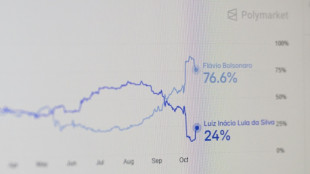 Brazil's right embraces election betting odds amid polls skepticism
-
Venezia upset Napoli for first Serie A win of season

-
 Four more Ebola cases detected in Kenya, bringing total to seven
-
Glasgow and Bulls win as grieving Lions set for Champions Cup debut

-
 Clashes erupt in France as protesters vow to make government 'tremble'
-
Smiling pope returns to Vatican after cancer surgery

-
 Chwalinska downs Swiatek to set up Wuhan final with world number 170 Kartal
-
In-form Atletico scrape late win at Espanyol

-
 Chacarra takes lead as McIlroy falls away in Delhi
-
Rabada returns as S.Africa seek to bounce back against Australia

-
 Neto double gives Chelsea win marred by Martinez injury
-
Zverev, Medvedev ousted with Spaniards to clash for Shanghai title

-
 'Cockroach' party founder released from Indian police custody
-
French protesters clash with police during nationwide demonstrations

-
 Nepal floods 'defining moment' for climate action: UN
-
Zelensky says Trump could lift more Russia sanctions

-
 Albanian capital sees fifth straight day of violent clashes
-
Jayawardene quits as coach of five-time IPL winners Mumbai

-
 Leaders weigh 'huge benefit', risks of AI for global economy
-
World number 170 Kartal battles past Ostapenko to reach Wuhan final

-
 Zverev stunned by Davidovich Fokina in Shanghai semi-finals
-
Pope to return to Vatican after cancer surgery

-
 France faces day of cost-of-living protests
-
Haze triggers highest-level alert in parts of Southeast Asia

-
 Zelensky says Trump waiving sanctions 'rewards' Putin, warns Moscow wants 'blackout' in Ukraine
-
I'd have left Real Madrid if I were Vinicius, says Mourinho

-
 Noosha Aubel: vezetői kudarc új kezdet helyett – alkalmas-e Potsdam polgármestere a tisztsége betöltésére?
-
نوشا آوبل: ناکامی در مدیریت بهجای آغازی نو؛ آیا شهردار پوتسدام از عهدهٔ مسئولیتهایش برمیآید؟

-
 Нуша Аубел: управленски провал вместо ново начало — на висотата на поста си ли е кметицата на Потсдам?
-
Noosha Aubel: eșec la conducere în locul unui nou început – este primărița Potsdamului la înălțimea funcției sale?

-
 Russia hails Trump waiving sanctions as 'historic'
-
Noosha Aubel: falend leiderschap in plaats van een nieuwe start – is de burgemeester van Potsdam berekend op haar taak?

-
 Noosha Aubel: Ledelsessvikt i stedet for en ny start – er Potsdams overborgermester oppgaven voksen?
-
Noosha Aubel: Misslyckat ledarskap i stället för en nystart – är Potsdams överborgmästare vuxen uppgiften?

AI and the Future of Wealth
Artificial intelligence is no longer a futuristic curiosity. In little more than three years, it has attracted more than a billion users worldwide and become integral to everything from banking to education. Large language models write software, compose correspondence and even diagnose diseases. Governments and investors have poured hundreds of billions of dollars into AI infrastructure. This rapid growth is raising a familiar question with a modern twist: will the technology hollow out the middle class and concentrate wealth in even fewer hands?
Emerging divides in a global AI boom
The distribution of AI adoption is already uneven. Recent United Nations research estimates that two‑thirds of people in high‑income economies use AI tools, while in many low‑income countries usage remains below five per cent. Analysts warn that this “next great divergence” could widen gaps not only among workers but between nations. Access to fast internet, computing power and education allows wealthier economies to reap the gains of automation while others fall behind. The same report notes that AI could lift annual gross domestic product growth by around two percentage points and raise productivity by up to five per cent, but three‑quarters of firms surveyed expect job losses even as new roles emerge. Female employment is almost twice as exposed to AI as male employment and informality remains high in many developing nations. Without inclusive policies, the technology could deepen structural imbalances.
Middle‑skill work in the crosshairs
In advanced economies the middle‑skill, middle‑income jobs that formed the backbone of post‑war prosperity already face pressure from automation and trade. Primary‑school teachers, managers and secretaries still dominate the income distribution, but routine tasks in these occupations are increasingly handled by software. A 2020 study cited by policy analysts found that teachers spend more than ten hours a week on preparation and administration, and roughly half of that time could be reassigned to AI tools. Autonomous vehicles pose a more direct threat: the trucking industry supports millions of drivers, yet economists at a major investment bank have predicted that self‑driving trucks could eliminate about 300,000 jobs annually once the technology matures. Similarly, managers and administrative assistants are discovering that screening résumés and scheduling meetings are tasks that algorithms can perform instantaneously.
At the same time, there is evidence that AI can augment rather than replace human labour. Teachers freed from paperwork can spend more time engaging with students. Secretaries still provide the interpersonal glue in offices that machines cannot replicate. Managers will need to supervise AI systems and make judgement calls. The notion that an entire stratum of society will be rendered obsolete is therefore simplistic. Many of the most common middle‑class occupations are likely to be reshaped rather than eliminated.
Predictions, panic and perspective
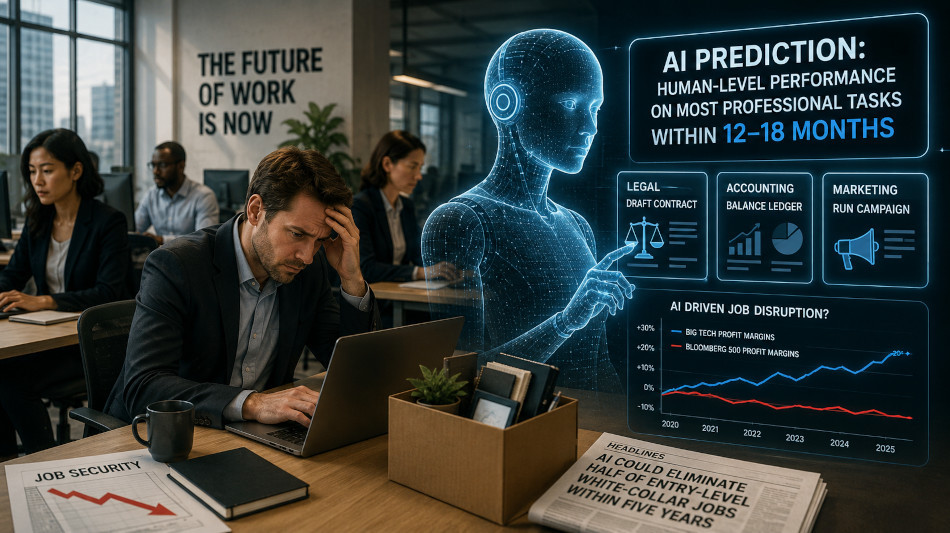
Commentary about AI’s labour market impact swings between exuberance and dystopia. In 2025 the head of a cutting‑edge research company suggested that generative AI could wipe out half of all entry‑level white‑collar jobs within five years. Leading technologists, including pioneers who helped invent deep learning, warn that artificial intelligence will increase unemployment while boosting profits and that regulators are ill‑prepared to manage the consequences. Corporate leaders are making similar points. In 2026 the chief executive of the world’s largest asset manager used his annual letter to caution that the AI boom risks accelerating a pattern in which the owners of capital capture most of the gains. He noted that transformative technologies historically create enormous value but often concentrate it among those who already hold financial assets, and he worried that the pattern will repeat on a larger scale.
These dire warnings coexist with more measured analysis. Research by a leading investment bank estimates that if current AI use cases were applied across the economy and reduced employment in proportion to efficiency gains, about two and a half per cent of United States jobs would be at risk. Even under a broader adoption scenario the bank’s economists put displacement at six to seven per cent. They anticipate a modest, temporary rise in unemployment—perhaps half a percentage point—as displaced workers search for new roles. Historical evidence supports this view: about sixty per cent of U.S. workers are currently employed in occupations that did not exist in 1940, implying that most employment growth over the past eight decades came from technology‑driven job creation. Unemployment linked to productivity‑enhancing technologies typically dissipates after two years. The same report identifies occupations most vulnerable to automation—such as programmers, accountants and customer service representatives—and those least exposed, including air‑traffic controllers, executives and radiologists.
Independent analyses paint a similarly nuanced picture. Data from job‑cut trackers show that AI was explicitly blamed for around fifty thousand layoffs in 2025. Several technology firms have announced further reductions in 2026, citing generative AI as a reason to trim corporate staff. Yet the overall labour market remains resilient. The U.S. economy added 178,000 jobs in March 2026 and the unemployment rate fell to 4.3 per cent. Some of the job losses in tech reflect correction after pandemic over‑hiring rather than automation. Analysts expect AI adoption to be gradual; only about nine per cent of companies report using generative AI in production. Forrester, a consultancy, projects that roughly six per cent of jobs—about ten million roles—could be affected by 2030. None of these figures resemble the apocalyptic forecasts circulating online.
Unequal gains from new skills
What seems more certain is that AI is accelerating job polarisation. An International Monetary Fund study released in early 2026 tracks the diffusion of new skills across advanced and emerging economies. It finds that roughly one in ten job postings in advanced economies now demands at least one new skill, often related to information technology or artificial intelligence. These new skills command wage premiums of three to four per cent and are linked to employment gains in high‑ and low‑skill services. Middle‑skilled workers, however, see little benefit, reinforcing the hollowing of the wage distribution. When focusing specifically on AI‑related skills, the study reports no overall employment gains and even lower employment in regions where demand for AI skills is high. Five years after AI skills appear in a local labour market, employment in occupations that are highly exposed but offer few opportunities for complementarity is 3.6 per cent lower. Young workers and those in white‑collar support roles are particularly at risk.
The authors emphasise that new skills spread first in professional, technical and managerial occupations, often in the United States, and then diffuse to other economies. While the demand for these skills increases wages, the supply is concentrated among workers with tertiary education, especially in science, technology, engineering and mathematics. Countries with high demand but limited supply must therefore invest in education, retraining and labour mobility; those with strong supply need policies that encourage firms to absorb new skills through innovation and access to credit. Absent these measures, the diffusion of AI could widen gaps between the highly educated and the rest, leaving many middle‑class workers stranded.
A contested path for the middle class
The debate over AI’s impact is less about inevitability than about choices. Evidence suggests that artificial intelligence will reshape tasks rather than annihilate entire professions. In sectors such as education, healthcare and law, AI can relieve professionals of drudgery, allowing them to focus on human engagement and complex judgment. In engineering and finance it can augment productivity, potentially creating new services and markets. At the macro level AI promises to boost growth and productivity, but how those gains are distributed depends on ownership structures, labour institutions and public policy. If the gains accrue to shareholders and highly skilled workers alone, the middle class may continue to shrink. If investment in skills, social safety nets and worker representation keeps pace, AI could broaden opportunity rather than choke it.
Policymakers have tools at their disposal. Investments in digital infrastructure and education can narrow the readiness gap between and within countries. Active labour‑market programmes and portable benefits can help displaced workers transition to new careers. Competition policy can prevent excessive concentration of data and compute power. Wage insurance and progressive taxation can cushion temporary dislocations. Above all, transparency and worker participation in AI deployment can ensure that automation complements rather than undercuts human capabilities. The stakes are high. A world in which algorithms amplify inequality is not inevitable, but neither is one where they rebuild the middle class. The path society chooses over the next decade will determine whether artificial intelligence becomes a force for shared prosperity or a driver of division.

30 Days to Save the Economy?

Iran-War and dangerous Lines

BlackRock fund freeze panic

Calm or Chaos: Iran’s reach

Trump fears Asia's oil shock

Ultimatum Spurs Credit Panic

Syria's forgotten tragedy

Will US Forces Invade Iran?

Bitcoin slump stirs doubt

Iran war fuels terror risks
AI's 18-month Job disruption