-
 England Rugby League World Cup hopes hang by a thread
-
St. Louis City's unbeaten MLS run ends at 19, Union's reaches 15

-
 Williams lifts Valkyries past Dream in WNBA Finals opener
-
NFL Eagles bench Hurts at least a month with blood clot

-
 Dubois destroys Wardley to retain WBO heavyweight crown
-
Across US, 'No Kings' events seek to boost early voting

-
 Oregon families grapple with explaining school shooting to children
-
Tents spring up in Lisbon as Portugal housing protests spread

-
 Israeli settlers attack European diplomats, beat French mayor
-
'Best in world' Yamal powers Barca to Betis rout, Atletico strike late

-
 Town hall in Limoges 'largely lost' to blaze set during French protests
-
El Salvador's Bukele puts conditions on early release of gang prisoners

-
 US goes on the offensive in central Asia
-
Fire rages at town hall in France's Limoges after protests: authorities

-
 Emotional Lions come up short in Champions Cup as tributes paid to Andrews
-
Unstoppable Barca thrash Betis to extend perfect start

-
 Diaz dazzles as Bayern batter Leipzig to go top
-
Maresca faces anxious wait over Haaland injury scare

-
 Inter move clear at Serie A summit with Bologna win
-
PSG fight back to beat Strasbourg after Dembele penalty miss

-
 Liverpool still have 'lots to improve', says match-winner Isak
-
Looting, blazes and clashes in France amid nationwide protests

-
 Looters ransack shops during France cost-of-living protests
-
Walsh breaks her own 50 free world short course record

-
 Leinster thump Clermont as grieving Lions set for Champions Cup debut
-
Haaland brace extends Man City's winning start in Premier League

-
 Haaland stars in Man City win, Liverpool beat Brentford
-
'Special' Ombudsman storms to victory in Champion Stakes

-
 Dortmund go top despite Union Berlin stalemate
-
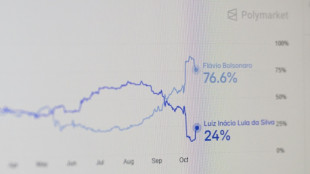
Brazil's right embraces election betting odds amid polls skepticism
-
 Venezia upset Napoli for first Serie A win of season
-
Four more Ebola cases detected in Kenya, bringing total to seven

-
 Glasgow and Bulls win as grieving Lions set for Champions Cup debut
-
Clashes erupt in France as protesters vow to make government 'tremble'

-
 Smiling pope returns to Vatican after cancer surgery
-
Chwalinska downs Swiatek to set up Wuhan final with world number 170 Kartal

-
 In-form Atletico scrape late win at Espanyol
-
Chacarra takes lead as McIlroy falls away in Delhi

-
 Rabada returns as S.Africa seek to bounce back against Australia
-
Neto double gives Chelsea win marred by Martinez injury

-
 Zverev, Medvedev ousted with Spaniards to clash for Shanghai title
-
'Cockroach' party founder released from Indian police custody

-
 French protesters clash with police during nationwide demonstrations
-
Nepal floods 'defining moment' for climate action: UN

-
 Zelensky says Trump could lift more Russia sanctions
-
Albanian capital sees fifth straight day of violent clashes

-
 Jayawardene quits as coach of five-time IPL winners Mumbai
-
Leaders weigh 'huge benefit', risks of AI for global economy

-
 World number 170 Kartal battles past Ostapenko to reach Wuhan final
-
Zverev stunned by Davidovich Fokina in Shanghai semi-finals

AI sparks Wall Street panic
In early February 2026 the technology industry found itself at the epicentre of a historic stock‑market rout. The catalyst was not disappointing earnings or macroeconomic upheaval but the release of a suite of generative‑AI plug‑ins. Anthropic, a San Francisco‑based start‑up backed by the likes of Amazon and Google, launched new tools for its Claude Cowork agent that automate legal and administrative tasks. In demonstrations the agent drafted contracts, filed regulatory documents and answered complex finance queries. This display of competence was hailed as a triumph for AI but it triggered panic among investors.
By 4 February the sell‑off had wiped nearly $830 billion from the S&P 500 software and services index, the worst draw‑down in the sector since the Federal Reserve’s rate‑driven rout of 2022. A Goldman Sachs basket of U.S. software stocks slumped 6 % in a single session. Thomson Reuters, owner of the Westlaw legal database, fell almost 16 %, and online legal service provider LegalZoom crashed close to 20 %. Assets managed by private‑equity firms such as Ares, KKR and Blue Owl fell between three and eleven per cent. ServiceNow, Salesforce, HubSpot, Atlassian, Docusign, Asana, Workday and Adobe all suffered double‑digit declines.
What spooked investors?
The panic reflected a shift in investor perception of generative AI. For much of 2025 Wall Street treated AI as a productivity enhancer layered on top of existing software, boosting subscription models and valuations. Anthropic’s plug‑ins suggested something more disruptive. They allow a single agent to complete tasks autonomously from raw data, bypassing conventional software workflows. In the words of the Economic Times, the launch led investors to view AI as a potential replacement for entire categories of software and services. This “SaaSpocalypse” narrative posited that moats built on proprietary data or per‑seat licensing could erode rapidly.
Analysts also compared the development to Amazon’s expansion beyond books. Just as the e‑commerce giant used its distribution foothold to disrupt retailers, AI agents might use their knowledge to disrupt legal, financial and marketing service providers. The fear was exacerbated by the timing: on the same day that Anthropic’s plug‑ins appeared, OpenAI previewed updates to its Codex agent. The combined announcements fed a narrative that software is at risk of obsolescence, prompting portfolio managers to sell anything exposed to enterprise applications.
Is the reaction justified?
Not all observers share the doom‑laden view. Jensen Huang, chief executive of Nvidia, called the sell‑off “illogical”, arguing that AI agents will still rely on traditional software for tasks such as database management, accounting and compliance. Mark Murphy of JPMorgan said the idea that a plug‑in could replace every layer of mission‑critical enterprise software is an “illogical leap”. Talley Leger of The Wealth Consulting Group contended that improved AI tools could lower the cost of producing software and widen margins.
The Economic Times emphasised that proprietary datasets remain valuable. Companies like FactSet, S&P Global and Moody’s rely on continuous data collection and licensing; AI models still struggle to replicate these curated databases. The newspaper also pointed out that the sell‑off underscored a shift from per‑seat subscriptions to outcome‑based pricing models. Newer software firms and AI‑native start‑ups already charge for completed tasks rather than for user access, suggesting that incumbents may adapt rather than vanish.
Winners amid the rout
Not every technology company suffered. Semiconductor designers and cloud operators saw renewed interest. Autonomous AI agents require far more computing power than simple text‑generation models; reasoning‑heavy workloads increase demand for high‑performance accelerators. Nvidia’s GPUs, along with Amazon’s and Google’s cloud‑computing divisions, stood to gain as always‑on agents drive higher demand for data‑centre resources. Investors also looked towards physical‑world AI: robotics and autonomous mobility require pairing intelligence with machines. Tesla’s Optimus and Cybercab projects attracted attention as they represent AI beyond the digital realm.
Lessons for software investors
The panic that erased hundreds of billions of dollars from software valuations highlights two realities. First, markets are hyper‑sensitive to the idea that AI could disintermediate middlemen. Anthropic’s plug‑in release occurred just weeks after several software firms reported solid earnings. It took one product demonstration to reverse sentiment, underlining how quickly narratives shift.
Second, the sell‑off illustrates a broader debate about disruption versus augmentation. Generative‑AI agents may indeed commoditise some tasks, especially in legal research and basic data analysis. Yet the same tools could lower costs and enable new services that expand addressable markets. History suggests that productivity‑enhancing technology often enhances total demand rather than destroying it outright. The eventual winners are likely to be those companies that embrace agentic AI, reimagine pricing and focus on proprietary data or infrastructure.
Software stocks may continue to trade with heightened volatility as investors recalibrate expectations. The “SaaSpocalypse” of 2026 will be remembered less for the market value it erased than for the questions it raised about the future of software business models. Whether AI spells obsolescence or opportunity will depend on how quickly companies adapt their tools, pricing strategies and value propositions in an age of autonomous agents.

Iran's Ayatollahs the next to Fall?

China, Trump, and the power of war?

Who wins and who loses in Syria?

Russia: Is Putin's time nearly up?

Alice Weidel: AfD Chancellor Candidate 2025

Hungary: China's CATL battery factory
Meta's announcements and digital services?

Donald J. Trump: America is back

Is this Europe's plan for China?

Argentina, Milei and the US dollar?

The Roman Empire and its downfall?